 Denys Danyliuk
Key Takeaways
- E101 on a Bosch oven means the temperature reading is lost through a broken wire or a failed sensor.
- It is a small, defined fault, so repair is the answer on an otherwise healthy oven.
- Do not use the oven with E101, because it cannot control its own temperature.
- A power cycle cannot fix a physical cable break.
- Replace only when E101 comes with several other faults on an old oven.
The Bottom Line
E101 is a cable or sensor fault, not a dead oven. Stop using it, get the probe and wire checked and replace the oven only if its age and other faults say so.
An E101 on a Bosch oven means the control cannot read the oven temperature, because the wire from the probe to the board has broken or the sensor behind it has failed. The Bosch oven E101 code page rates the fault as one that needs professional repair, and it sits among the smaller jobs on an oven, which is why a Bosch oven E101 repair or replace discussion usually ends in favor of repair.
| What you find | What it means | Verdict |
|---|---|---|
| Oven will not heat, display shows dashes or zero | The control gets no temperature reading | Repair: a sensor or cable fault |
| Probe wire visibly burned or broken | Heat has damaged the wire to the board | Repair: replace the wire or probe |
| Probe reads open circuit on a meter | The sensor or its connection has failed | Repair: a small, defined part |
| E101 plus a cracked cavity or a dead board | More than one fault in an aging oven | Weigh against the age of the oven |
What Does E101 Mean on a Bosch Oven?
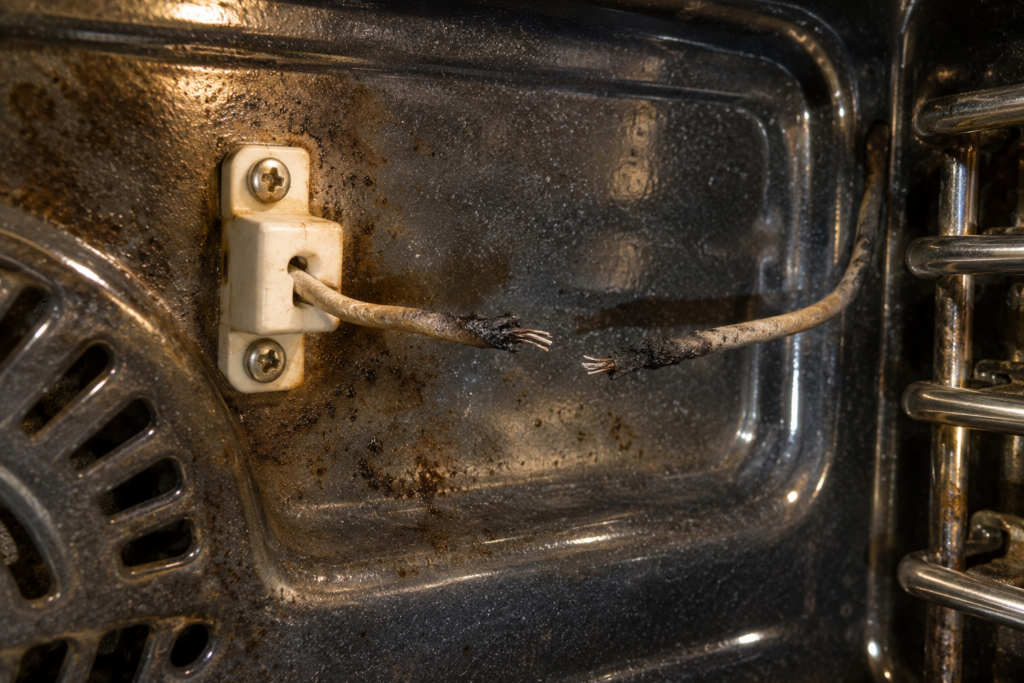
E101 means the oven has lost its temperature reading through a broken cable between the temperature probe and the control board. The code page lists two causes: a probe wire that has broken from heat damage and a failed PT500 sensor, the platinum resistance sensor that reports the cavity temperature.
With no reading, the oven does not know how hot it is. The page says it may not start heating at all, and in the worst case it could heat without limit, which is why it must not be used until it is repaired. The same code shows up under oven, range and stove entries on this site, so the page name depends on your appliance.
The wire is the part that suffers, because it runs through the hottest zone of the cavity. The page says the probe wire breaks from heat damage, which means the fault tends to appear on an oven that has seen years of use, rather than on a new one. That is one reason the age of the oven belongs in the discussion, though it rarely decides it alone.
Bosch Oven E101 Repair or Replace: Which Is It?
Repair is the answer in most cases, because a broken sensor cable is a small, well-defined fault on an oven that is otherwise sound. The page marks both causes as needing a professional, but neither one is a reason to buy a new oven.
- Repair when the oven is otherwise healthy. A single broken wire or sensor does not mean the cavity, the elements or the board are worn.
- Repair a built-in oven in particular. Replacing one means matching the cutout and sometimes altering the cabinet, which costs more than the part.
- Replace only for a combination. An old oven with E101, a failing board and a worn door seal is where the total starts to matter.
- Ask for the written estimate. It turns the question from a feeling into a number.
Our parent guide, should you repair or replace a Bosch oven, covers the whole machine, and our E305 repair or replace guide covers a different code.
Think about what a replacement involves. A new built-in oven has to match the cutout, the electrical supply and the trim, and the old one has to come out of the cabinet first. A repair keeps all of that as it is. The probe and the wire are small parts compared with a whole oven, which is why the fault belongs in the repair column.
How Age and Installation Tip the Decision
Two questions matter more than the code itself: how old the oven is and how it is installed. A free-standing range is easy to swap. A built-in double oven in a cabinet tower is not, and the cost of removing it can exceed the cost of the fix.
- In the first half of its expected 12 to 15 years and sound: repair, since a single sensor fault does not shorten the life of the rest.
- Built in to cabinetry: repair is even more likely, because a new oven must match the cutout and the trim.
- Old, with a worn door seal and a flaky display: add up the faults before you spend on one of them.
- A second sensor fault soon after the first: look at the wiring and the board, not only at the probe.
These are rules of thumb, not a verdict. The written estimate after a diagnostic is what turns them into a number for your oven.
Is It Safe to Use a Bosch Oven With E101?
No. The code page says that without temperature sensing the oven could overheat uncontrollably, and it tells you not to use it. Stop if the oven will not heat, if it heats without stopping or if the display shows no temperature reading.
- Do not use the oven for cooking. There is no control over how hot it gets.
- Do not rely on a reset. A cable break is a physical fault, and the page says it cannot be reset away.
- Switch it off at the breaker if it keeps heating. That is the only safe way to stop it.
Will a Power Cycle Help?
No, not for a real cable break. The page suggests turning the breaker off for five minutes and trying again, which can only rule out an electronic glitch. A physical break stays broken, so if E101 returns, stop testing and arrange a repair.
What the Technician Checks
The technician measures the resistance of the probe and looks at the wire and the connector for damage. The code page names the signs to look for: a probe that reads open circuit, a wire that is visibly damaged or burned and a corroded connector.
- Confirm E101 and the missing temperature reading.
- Measure the probe resistance and check for an open circuit.
- Inspect the wire and the connector for burn marks or corrosion.
- Replace the damaged wire or the probe and test the oven to temperature.
- Give you the written estimate before any part is fitted.
The test at the end matters. Ask the technician to bring the oven up to a set temperature and hold it there for a few minutes before leaving, so you can see that it heats, that it stops where it should and that E101 does not come back while they are still in the kitchen.
When Replacing the Oven Does Make Sense
If the oven is old and E101 is one of several faults, do the sum on the whole machine. The is it worth repairing a Bosch oven guide shows where age and condition tip it. For overheating, see our oven overheating safety guide.
Our Bosch oven repair service covers the probe, the wire and the connector. Book a visit or tell us what the display shows so the right part comes on the first trip.