 Denys Danyliuk
 Key Takeaways
- Bosch washing machine error codes are grouped by what the machine measured, so sort them by fill, drain, door, and stop-now before troubleshooting.
- Write the exact code and the point in the cycle down before clearing it — the machine keeps no history you can read.
- E13 and E18 both point first at the drain pump filter behind the flap at the bottom front of the machine.
- E17, E23, F21, and E32 are not invitations to experiment: stop the cycle and get a diagnosis.
- E43 is the one code that is genuinely yours — redistribute an unbalanced load and restart.
The Bottom Line
Filters, hoses, taps, seals, and load balance are homeowner territory; the pump, inlet valve, door lock, heater, and motor are not. Record the exact code before you clear it, and let that decide which side of the line you are on.
A Bosch front loader does not fail quietly. It stops, it posts a code, and it waits. The trouble is that Bosch washing machine error codes are grouped by what the machine measured, not by what you are supposed to do about it, so two codes that look almost identical on the display can mean a five-minute job and a service call. This chart sorts the codes this site documents by what they are actually about, so you can tell those two apart before you start pulling the machine out from the wall.
| Code | What the machine measured | What it usually means for you |
|---|---|---|
| E02 | No water is entering the machine | Inlet hose, shutoff valve, or house water pressure |
| E04 | The door is not properly closed or latched | Laundry caught in the seal — close it again firmly |
| E13 | Water is not draining properly from the drum | Blocked drain filter or a kinked hose |
| E17 | The water level has risen dangerously high | Stop the cycle now — inlet valve or pressure system |
| E18 | The drain pump timed out emptying the drum | Blocked pump filter or kinked hose |
| E23 | Flood protection activated — water in the base tray | Something is leaking inside the cabinet |
| E27 | The door lock has malfunctioned | The machine will not start at all |
| E29 | The water inlet valve has faulted | Erratic filling, heading toward overfill or no fill |
| E32 | The drum has stopped turning | High severity — clothes left soaking wet |
| E43 | The load is too unbalanced to spin safely | Redistribute the laundry and restart |
| F01 | A leak at the inlet valve | Catch it early to prevent floor damage |
| F02 | The heating element is defective | Washing at the wrong temperature |
| F21 | A critical motor fault | Washing has stopped entirely — diagnosis needed |
The Same First Move for Almost Every Code
Whatever the display says, the opening sequence rarely changes. Write the code down before you clear it, because the machine does not keep a history you can read, and an intermittent fault that nobody wrote down is a fault nobody can chase.
- Record the exact characters. E18 and E13 are both drainage, but they are not the same measurement, and the difference tells a technician where to start.
- Note where in the cycle it appeared. A code at the fill stage, at the drain stage, or at the spin points at three different sections of the machine.
- Cut power before anything else. Unplug the washer, or switch off its circuit, before opening a filter or moving the machine.
- Close the water. For anything involving filling, leaking, or overfilling, shut the supply taps behind the machine first.
Codes About Water Coming In
Four codes describe the fill side, and they are worth reading as a sequence rather than as separate faults. E02 is the simplest: no water is entering, so the cycle cannot start. The causes are usually outside the machine — a closed shutoff valve, a crushed inlet hose, a clogged inlet screen, or low pressure in the house.
E29 is the same circuit gone unreliable rather than dead: the inlet valve itself has faulted and fills erratically. Left alone, that drifts in one of two directions, and both have their own code. F01 is a leak at that valve, which matters long before it becomes a puddle you can see. E17 is the serious end: the water level has risen dangerously high, and the correct response is to stop the cycle immediately rather than to investigate.
Codes About Water Going Out
Two codes cover drainage, and between them they account for a large share of the service calls this site sees on Bosch washers. E13 reports that water is not draining properly from the drum. E18 is more specific: the drain pump ran and timed out without emptying the drum.
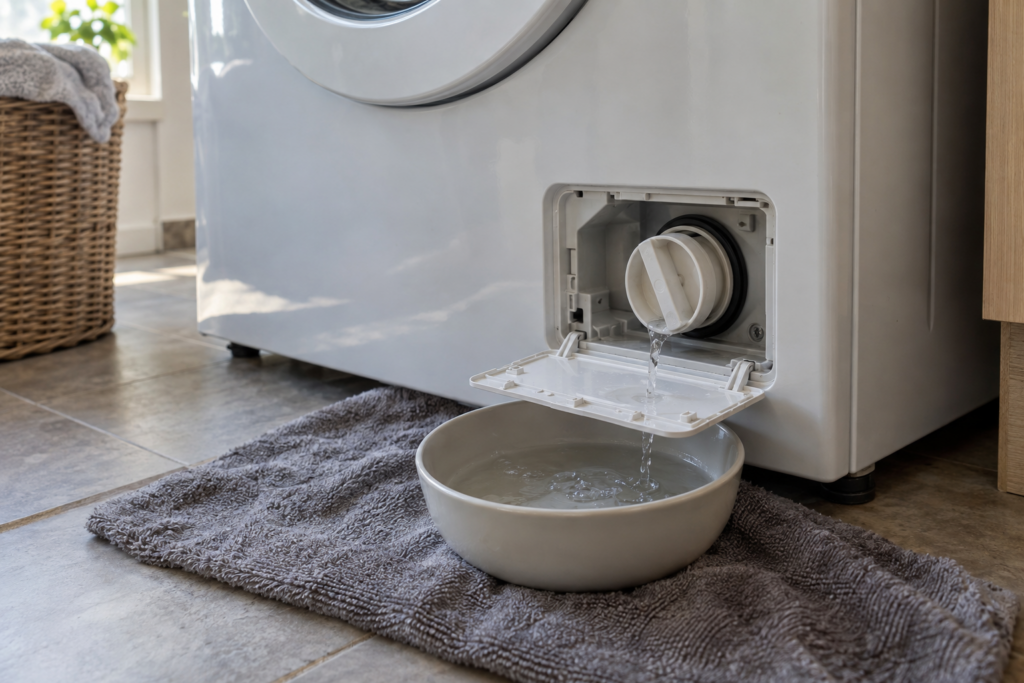
In both cases the first suspect is the same, and it is the part most owners have never opened. Behind the small door at the bottom front of the machine sits the drain pump filter, sometimes called the coin trap. It collects the buttons, hairpins, and lint that would otherwise reach the pump impeller, and it is meant to be cleaned periodically rather than when something goes wrong. Have a shallow dish and a towel ready — there is more water behind that cap than people expect, and it comes out sideways.
- Switch the machine off at the wall and let any hot water cool.
- Open the service flap and lay a towel with a flat dish against the cabinet.
- Unscrew the filter cap slowly and let the water drain in stages.
- Clear the filter, check the impeller turns freely, and refit the cap firmly.
- Pull the machine out and check the drain hose for kinks and sharp bends.
Codes About the Door
Two more codes stop the machine before it ever starts. E04 simply means the door is not properly closed or latched, and the usual cause is a corner of laundry caught in the rubber seal. Press the door firmly until the latch clicks and it clears.
E27 looks the same from the front and is not the same at all: the door lock itself has malfunctioned, and the washer will not start. A front loader will not run with an unconfirmed lock under any circumstances, because the drum spins fast enough that the interlock is a genuine safety device rather than a convenience.
The Codes That Mean Stop, Not Troubleshoot
Four codes on this list are not invitations to experiment. E23 means flood protection has activated because water has collected in the base tray — something inside the cabinet is leaking, and the machine has already decided to protect the room. Our guide to preventing a washer flood covers what to do with the supply taps in that situation.
F21 is a critical motor fault and E32 reports that the drum has stopped turning, leaving clothes soaking wet — both need a diagnosis rather than a reset. F02 is quieter and easy to ignore, because the machine keeps working: the heating element is defective, so the wash runs cold no matter what you select. It is a hygiene problem rather than a hazard, but it does not repair itself.
One code on the list is genuinely yours to fix and is the most common of all. E43 means the load is too unbalanced to spin safely — a single bath mat, a duvet, or four heavy towels that migrated to one side. Redistribute the laundry and restart. The full list of codes this site documents lives on the washer error code index.
When to Hand It Over
The dividing line is consistent across this whole chart. Filters, hoses, taps, door seals, and load balance are yours. The pump, the inlet valve, the door lock, the heating element, the motor, and anything reported by the flood tray are not, because reaching them means opening the cabinet on a machine that combines mains voltage with standing water.
Our Bosch washer repair service covers all of those, and a diagnostic visit starts from $89. The final price is confirmed after the on-site diagnosis, and you receive a written estimate before any work begins. You can book a visit or send us the code and the model number, and the right parts are far more likely to arrive on the first trip.