 Denys Danyliuk
Key Takeaways
- E011 on a Bosch oven means a control panel button is physically stuck, not an electronics or heating fault.
- It is low severity but worth fixing early, because a stuck button can jam neighboring buttons over time.
- A careful clean of the button and its seam sometimes clears the code without any visit at all.
- E011 is unrelated to E005, a display communication fault that is more serious and needs power cut at the breaker.
- Fixing a stuck button early is a small repair; an unresponsive panel later is a full panel replacement.
The Bottom Line
E011 is a stuck control panel button — low severity, low cost, and worth fixing right away rather than waiting. Clean the button and the seam around it first; if it stays stuck, a technician visit is inexpensive compared with letting it spread to the rest of the panel.
E011 means a control panel button is physically stuck, and the site rates it a low-severity issue — but it also warns that leaving it alone tends to spread, since a stuck button can jam the rest of the panel over time. It is one of the least serious faults an oven can post, and fixing it is usually a quick yes.
| What you see | What it means | What it takes to fix |
|---|---|---|
| One button feels sunken or unresponsive | Mechanical button stuck under the panel | Cleaning or a panel overlay, from $89 |
| Button works but only sometimes | Debris or a worn contact underneath it | Diagnostic, from $89 |
| Adjacent buttons start misbehaving too | Stuck button pressing on neighboring contacts | Panel service, from $139 |
| Whole panel becomes unresponsive | Left unaddressed for an extended period | Panel replacement, from $249 |
| Oven still cooks normally otherwise | Fault is contained to the panel | Low-cost, worth fixing |
What Does Bosch Oven E011 Mean?
E011 means a control panel button is stuck, preventing normal operation. The site documents it on the oven E011 error page as low severity but notes it needs fixing before other buttons stop working, which is the detail most owners miss. This is not a code about heat, electronics, or safety systems — it is purely mechanical, a single button that is not springing back the way it should.
Ovens with touch or membrane-style control panels rely on individual buttons registering a clean press-and-release. Food residue, spilled liquid that dried under the panel edge, or a worn spring behind one button is usually all it takes for the board to see a button as permanently pressed, which is exactly what E011 reports.
Is Bosch Oven E011 Worth Fixing?
Yes. A stuck button is one of the cheapest control faults an oven can develop, and fixing it early is far less expensive than waiting for it to take the rest of the panel with it. Compare this to the appliance's other common panel faults — a full control board replacement runs well into the hundreds of dollars — and a single stuck button caught early is a comparatively small repair.
Our broader guide on whether a Bosch oven is worth repairing covers the wider decision by age and repair history; a stuck button sits firmly on the "repair it" side of that guide regardless of the oven's age, because the part itself is inexpensive and the alternative is a panel that eventually stops responding altogether.
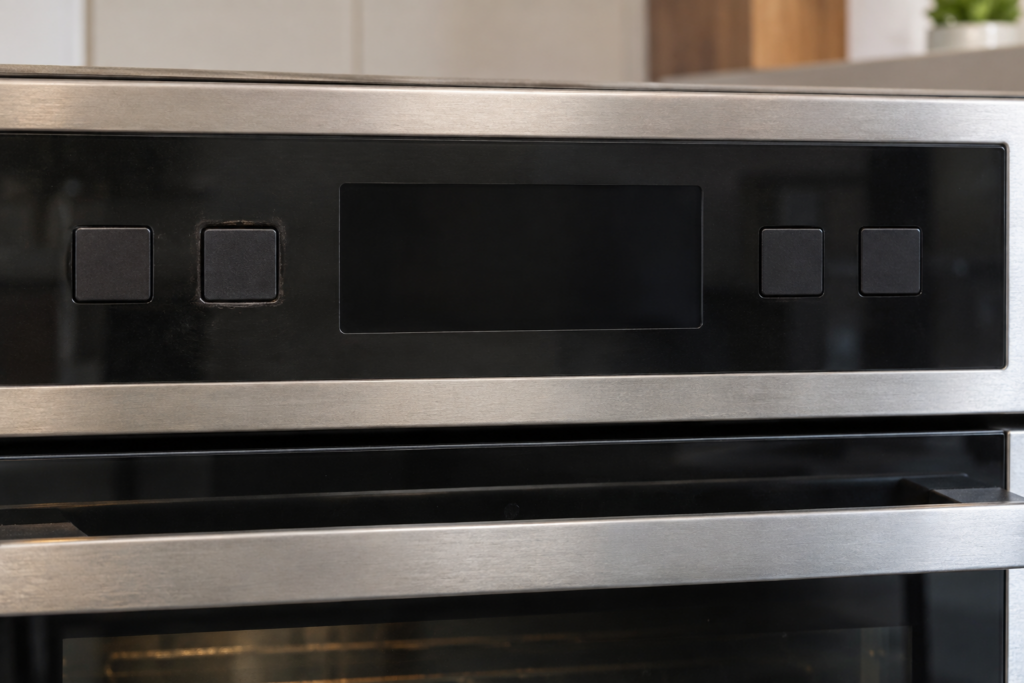
The One Check Worth Doing Yourself
Before booking anything, there is a single homeowner check worth making, because it sometimes clears the fault without a visit at all. It costs nothing, takes a few minutes, and is the same first step a technician would take on arrival, so there is little downside to trying it yourself first.
- Turn off power to the oven at the breaker before touching the panel.
- Wipe the surface of the stuck button and the seam around it with a barely damp cloth — no spray cleaner directly on the panel.
- Dry the area completely and restore power.
- Press the button firmly once and check whether it springs back normally.
- If it stays sunken or unresponsive, stop there and book the diagnostic rather than pressing repeatedly.
Pressing hard or repeatedly on a stuck button rarely helps and can push contamination further under the panel, which is the opposite of what you want if a technician later needs to access it cleanly.
Why Not Just Wait and See?
Waiting is the one thing the site specifically warns against, and the mechanism is straightforward: a button that stays physically depressed keeps pressure on the membrane layer beneath the panel, and that layer is shared across multiple buttons on most designs. Left long enough, a single stuck button can drag neighboring buttons into misbehaving too, turning a one-button fix into a full panel replacement.
- A single stuck button is a small job. Cleaning or a targeted overlay repair typically resolves it without touching the rest of the panel.
- Multiple affected buttons mean the membrane is compromised. At that point the repair usually becomes a panel service rather than a spot fix.
- An unresponsive panel means full replacement. This is the outcome the early fix is meant to prevent, and it costs several times more.
E011 Is Not the Same as a Dead Display
It is worth distinguishing E011 from a more serious communication fault some owners find while searching. E005 means the display has lost communication with the control board entirely — the panel goes blank or frozen and nothing responds, which is a genuinely different situation that calls for cutting power at the breaker. E011 is much narrower: everything else on the panel works fine except the one stuck button.
If your oven still displays correctly and only one control feels off, you are looking at E011, and there is no reason to treat it with the same urgency as a communication fault.
- Display works, one button feels stuck: E011, low severity, clean it and try again.
- Display blank or frozen entirely: E005, cut power at the breaker.
- Display works, oven will not heat: unrelated heating fault, see below.
- Not sure which one you have: describe exactly what the display shows when you call.
If the Oven Also Will Not Heat
A stuck button on its own does not affect heating. If your oven shows E011 and separately will not reach temperature, those are two unrelated faults, and our guide to a Bosch oven that will not heat covers the heating side on its own terms rather than assuming the panel is responsible. Confirming which fault you actually have before booking a visit matters, because a heating fault and a stuck button are diagnosed and priced completely differently, and mixing them up on the phone can send the wrong parts out on the truck.
It is also worth checking the model number before assuming a repair is even possible. Most current Bosch wall ovens and ranges use a serviceable membrane panel that can be cleaned or partially replaced, but very old models occasionally used a design where the whole control assembly is one sealed unit. A technician can tell you which one you have within minutes of looking at the panel from the back, and it changes whether the fix is a targeted repair or a full panel swap.
Getting the Panel Checked
A technician can usually tell within minutes of arriving whether cleaning, a contact repair, or a panel replacement is needed, and catching it at the cleaning stage is the cheapest of the three by a wide margin. Our Bosch oven repair service covers the control panel and its membrane layer, and a diagnostic visit starts from $89. The final price is confirmed after the on-site diagnosis, and you get a written estimate before any work begins. You can book a visit or tell us which button is affected and for how long, and we will tell you what the visit is likely to involve.